Avant converts base tokens back into underlying assets through redemption requests
Avant base-token redemption returns the product's backing asset after you complete a redeemable request. If you're eligible, open the product page in Avant's app and choose Redeem under Mint or Redeem. Check your base-token balance, native network, and gas funding; enter the amount and review output and fees before approving and confirming. Active Redemptions shows its progress and provides the completion action when the request is ready.
Avant's app has age and territorial restrictions, including exclusions for U.S. residents, citizens, and people located there. Senior and Junior positions must first convert to base tokens for protocol redemption. Selling through available Swap liquidity follows a separate route, with its own quoted output and execution conditions.
The Base-Token Balance Required for Redemption
Protocol redemption uses the base token for the selected product, so a Senior or Junior balance requires an earlier conversion. The token you receive from that conversion determines which base-token request you can submit.
Senior Unstaking Before the Base-Token Exit
Senior unstaking returns the corresponding base token after a cooldown, which is 24 hours for savUSD, savBTC, savETH, and savkBTC. The dashboard shows the request's readiness time, and the selected funds earn no yield during cooldown. Once they're ready, Withdraw sends the base tokens to your wallet. That output remains a protocol token until you redeem it for its underlying asset.
Junior Redemption Before the Backing-Asset Payout
Junior redemption returns the corresponding base token after its one-week waiting period and completion from Active Redemptions, so that conversion precedes the backing-asset exit described here. The requested amount earns no yield during this wait, and settlement can reflect price downside. Keep that conversion's output distinct from the later base-token redemption quote.
Protocol Redemption and Liquidity Sales
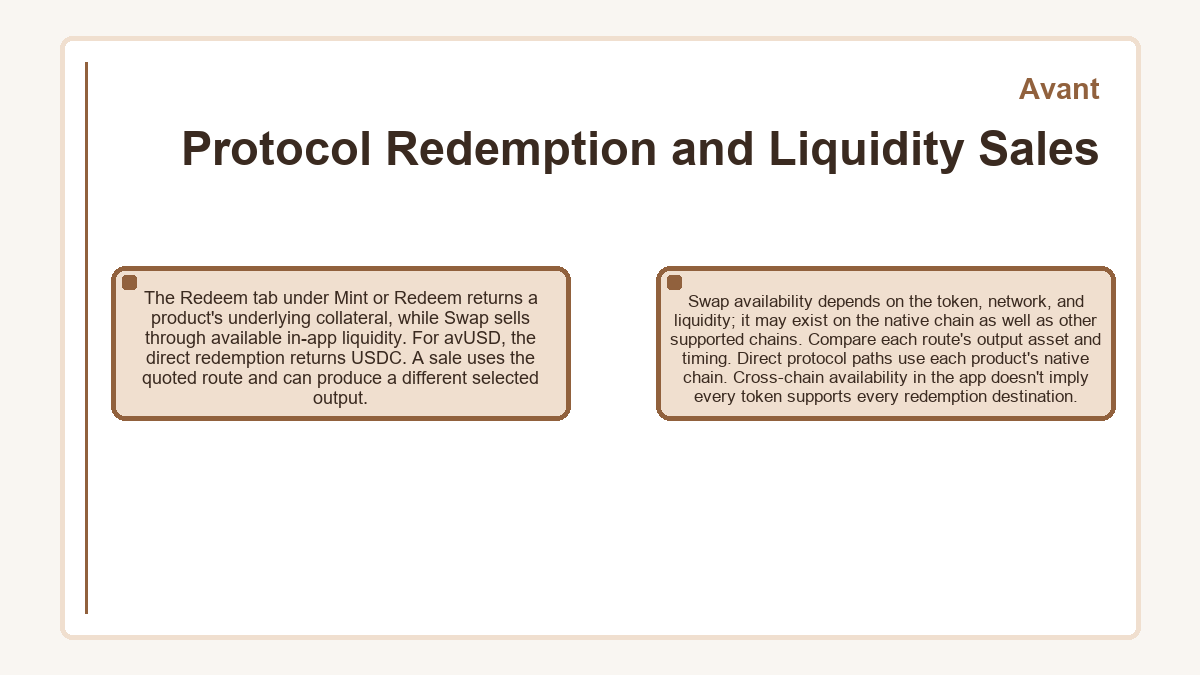
The Redeem tab under Mint or Redeem returns a product's underlying collateral, while Swap sells through available in-app liquidity. For avUSD, the direct redemption returns USDC. A sale uses the quoted route and can produce a different selected output. Swap availability depends on the token, network, and liquidity; it may exist on the native chain as well as other supported chains. Compare each route's output asset and timing.
Direct protocol paths use each product's native chain. Cross-chain availability in the app doesn't imply every token supports every redemption destination.
Expected Output and Transaction Costs
The redemption quote identifies the base-token amount you're giving up and the underlying-asset amount you expect to receive. These are separate token quantities, and a displayed dollar value doesn't change the output token.
Underlying Asset and Network
The native networks differ across product families: avUSD and avBTC use Avalanche, avETH uses Ethereum, and avkBTC uses Ink. The two Bitcoin families also use different collateral, BTC.b and kBTC respectively. Match the token, network, and recipient to the selected route. avkBTC doesn't currently support bridging, while eligible flows for other products can include cross-chain movement, with included stages shown in route details.
Redemption Fees and Gas
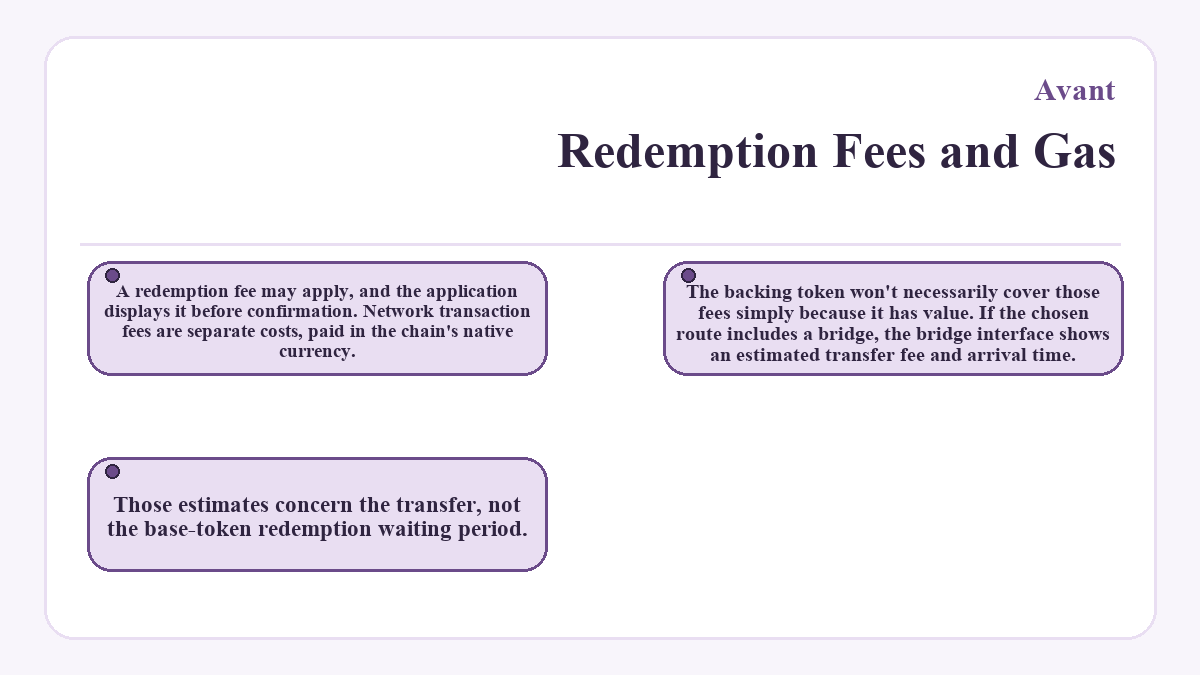
A redemption fee may apply, and the application displays it before confirmation. Network transaction fees are separate costs, paid in the chain's native currency. The backing token won't necessarily cover those fees simply because it has value. If the chosen route includes a bridge, the bridge interface shows an estimated transfer fee and arrival time. Those estimates concern the transfer, not the base-token redemption waiting period.
Approval, Authorization, and Submission
Token approval permits the relevant contract to use the selected base-token amount, while redemption authorization concerns the conversion terms. In AvantMintingV2, signed orders include the base-token amount, collateral amount, recipient, and expiry. These fields distinguish what's consumed from what's paid out. A signature authorizes the order; execution performs the conversion. The contract burns the specified base-token amount and transfers the specified collateral to the recipient.
The Redeem flow submits the request for processing. Approval alone doesn't establish a pending redemption, so look for the submitted request in Active Redemptions. Wallet confirmation, request submission, and delivery of the underlying asset describe different events.
When Does a Base-Token Request Become Redeemable?
A base-token redemption can take up to seven days, with timing affected by liquidity and other conditions. Active Redemptions shows the individual request's progress through this base-token processing period. A prior Senior cooldown or Junior redemption has its own timing, so it doesn't replace the later processing period. An exit beginning in a yield-bearing token therefore includes the earlier conversion as well as the base-token redemption.
Completing a Mature Request
Base-token redemption requests require completion from Active Redemptions once they become redeemable. The relevant output is the underlying asset specified by the request.
A Ready Request and Its Backing-Asset Payout
The underlying-asset payout completes the exit in this hypothetical case. Assume the base-token request has become redeemable and its completion succeeds. The holder completes the request from Active Redemptions, and the recipient wallet receives its specified backing-asset payout.
A readiness indication shows the request can proceed. Approval and a pending request, by themselves, don't establish receipt of the backing asset.
Pending Changes and Liquidity Constraints
Pending base-token redemptions can be cancelled or adjusted before finalization. Submitting a replacement with the desired amount updates the existing order; it doesn't create an additional independent request. This replacement behavior belongs to base-token redemptions; Junior requests follow different rules, so a change must follow the process for the token you're exiting.
Liquidity pressure can delay withdrawals when exceptionally large volumes are redeemed together. Large redemptions may require additional processing while the protocol sources and transfers assets. The seven-day guidance shouldn't be treated as a guaranteed delivery deadline during exceptional liquidity pressure. Until the payout arrives, those redemption proceeds aren't available for your next transfer.
Avant questions, answered
-
Can I Redeem avUSD Acquired Through Swap?
- avUSD acquired through a supported Swap route can be redeemed through the direct protocol redemption flow on Avalanche. Minting the token yourself isn't a separate prerequisite; you need the avUSD balance for the request. A sale quote and a protocol redemption remain different exit routes, even when the starting token is identical.
-
Do I Have to Redeem My Entire base-token Balance?
- The redemption flow lets you enter the base-token amount you want to redeem. You can request an amount within your available balance without treating the entire holding as one mandatory exit. The selected amount determines the request's input, and its quoted underlying-asset output determines the expected payout.
-
Will a Pending avUSD Redemption Earn Additional Yield?
- avUSD doesn't earn yield for its holder, so a pending avUSD redemption doesn't add Senior or Junior staking rewards. Yield-bearing tokens have their own conversion rules before the base-token exit. Waiting for the base-token request to become redeemable doesn't turn that base balance into a yield-bearing position.
-
Is AVAX Needed for an avUSD Redemption?
- AVAX pays network transaction fees for the direct avUSD redemption path on Avalanche. USDC is the product's backing asset and doesn't replace the native gas token. The AVAX needed depends on the transactions you submit and their network fees; a fixed amount can't describe every redemption.
-
What Does SignatureExpired Mean in AvantMintingV2?
- SignatureExpired means the contract is attempting to execute an order after its signed expiry time. AvantMintingV2 checks the order's expiry against the block timestamp. This concerns the validity of that signed order; it doesn't specify a universal deadline for every request displayed in Active Redemptions.
-
Who Can Execute an AvantMintingV2 Redemption Order?
- Only an address with REDEEMER_ROLE can call AvantMintingV2's redeem function. Your signature authorizes the order, while an authorized protocol operator submits its on-chain execution. Signing an order doesn't grant the caller that role.
-
Does an avETH Redemption Automatically Return Native ETH?
- If an avETH redemption specifies WETH as its output, it pays WETH rather than native ETH. WETH and ETH appear as different wallet balances. The selected route's output identifies what you'll receive, while Ethereum transaction fees use native ETH.
-
Must I Disclose My Recovery Phrase to Complete a Redemption?
- You don't need to disclose your recovery phrase to approve or complete a redemption. Your wallet handles authorization without sharing that phrase with the application. A request for the phrase isn't part of the redemption process; keep it private even when a message claims to help finish a pending request.
Last updated