Avant tranches and Junior Capital Loss Buffers
Avant tranches divide strategy exposure into Senior and Junior positions, with Junior capital absorbing losses after reserves and before Senior capital. Junior holders receive an additional yield allocation for this exposure. Senior protection depends on the available reserves and Junior buffer, which can be depleted.
A Junior exit stops yield accrual during cooldown while retaining downside exposure, so requesting redemption doesn't freeze its payout.
Senior Tokens, Junior Tokens, and Reserve Capital
Senior tokens carry the later loss position, Junior tokens provide subordinated capital, and the Reserve Fund supplies protocol-owned protection. Staked Senior tokens earn yield through their growing value relative to the corresponding base token. Junior tokens combine yield participation with earlier exposure to strategy losses. The reserve belongs to the protocol and supports the capital structure without becoming another user-held tranche token.
Base tokens and staked Senior tokens share Senior loss priority. Their yield treatment differs: holding an unstaked base token doesn't credit strategy earnings to its holder. Staking adds the yield-bearing form of that Senior position. Boosting creates Junior exposure.
When Can Strategy Losses Reach Senior Capital?
Strategy losses reach Senior capital after the applicable Reserve Fund and Junior loss buffer have been exhausted. Seniority establishes a position in the loss waterfall. The protection ahead of that position consists of finite capital, so a sufficiently large deficit can reach it.
The Reserve Fund covers the initial deficit using protocol-owned capital. Only the loss remaining after that available buffer passes to Junior capital.
Junior capital then bears the uncovered loss before Senior capital. This can reduce the value represented by Junior tokens, including their claim on the corresponding base asset. Partial consumption of this layer leaves less capital available to protect Senior positions against a further deficit. Its capacity depends on committed value, rather than simply the number of Junior tokens issued.
A loss exceeding those funded layers can reduce Senior capital as well. Ranking later in the waterfall doesn't establish a fixed repayment floor. A buffer balance measured before a loss doesn't remain available after that capital has been consumed.
Loss allocation also differs from loss prevention. The waterfall assigns a deficit among capital layers after a strategy incurs it. Contract controls and portfolio diversification address the conditions producing losses. They don't create additional loss-absorbing capital merely by existing, and their operation shouldn't be counted as a reserve balance.
The Planned Governance Backstop
The governance backstop is a proposed protection layer funded by staked governance tokens between reserves and Junior capital. This would put governance capital ahead of both user tranches. Until that layer is implemented and funded, existing protection rests on the available reserves and Junior buffer.
Reserve Funding and Product Boundaries
The Reserve Fund receives part of protocol performance-fee revenue and part of the yield generated by unstaked base-token backing. Reserve assets remain productive: the protocol manages them in the relevant base tokens and retains their returns within the fund. Reserve growth still depends on revenue and investment performance, while covering deficits consumes its capital.
USD, BTC, and ETH reserves serve their respective asset suites. The BTC Reserve Fund covers both the avBTC and avkBTC families. Those families retain distinct collateral and tranche tokens despite this shared reserve relationship. Separate reserve accounting therefore doesn't imply a separate reserve for every individual product. A protocol-wide total also can't establish how much protection belongs to a particular Senior position.
The Junior Share of Strategy Earnings
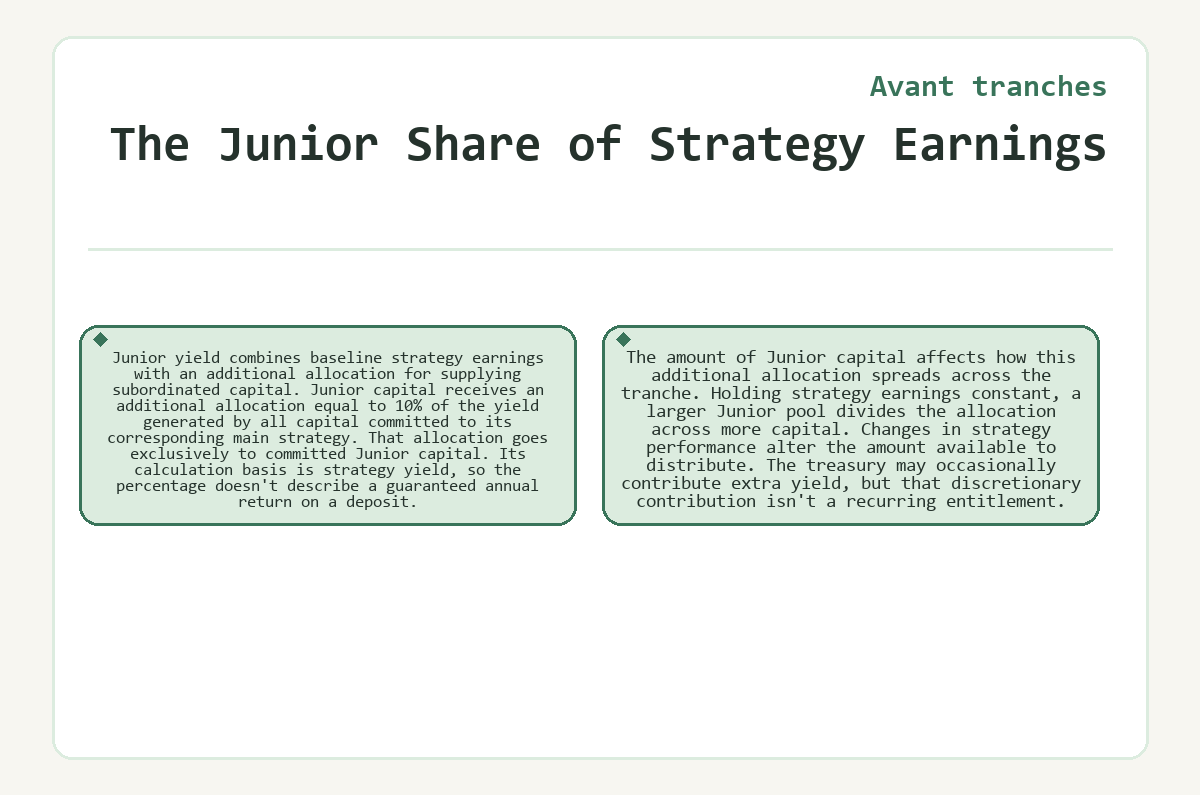
Junior yield combines baseline strategy earnings with an additional allocation for supplying subordinated capital. Junior capital receives an additional allocation equal to 10% of the yield generated by all capital committed to its corresponding main strategy. That allocation goes exclusively to committed Junior capital. Its calculation basis is strategy yield, so the percentage doesn't describe a guaranteed annual return on a deposit.
The amount of Junior capital affects how this additional allocation spreads across the tranche. Holding strategy earnings constant, a larger Junior pool divides the allocation across more capital. Changes in strategy performance alter the amount available to distribute. The treasury may occasionally contribute extra yield, but that discretionary contribution isn't a recurring entitlement.
Daily Senior Accrual and Weekly Junior Updates
Senior yield accrues in daily portions of finalized weekly earnings, while Junior yield enters token value through weekly updates. The weekly epoch begins on Thursday and accounts for the preceding week's performance. Junior distributions coincide with that weekly cycle. Senior daily increments spread the finalized allocation across the following distribution period. Because the Junior allocation posts weekly, comparing a single day's value movement can miss its earnings.
Token Value and Portfolio Valuation
A tranche token's redemption value measures the corresponding base-token amount represented by each token, while its wallet balance measures token units. Yield increases the value per unit as distributions accrue. Junior losses can move that value downward. Comparing token counts without their exchange values can therefore misstate how much capital each position represents. Senior and Junior balances need their own valuation because their yield allocations and loss priorities differ.
Portfolio net asset value, or NAV, accounts for the strategy assets and liabilities underlying those claims. Avant uses weekly portfolio valuation by PennyWorks. For MAX Junior tokens, PriceStorage records the base-token value used by the conversion system. An authorized service updates that price within configured bounds. Portfolio valuation and the stored conversion price are separate components; an on-chain price record doesn't itself perform the portfolio accounting.
Cooldown Exposure and Junior Settlement Prices
Senior and Junior exits stop yield accrual during their respective cooldowns, with Junior capital retaining exposure to falling value. Senior unstaking uses a one-day cooldown. Junior conversion uses a one-week burn-request cooldown. These waits concern conversion into the corresponding base token; the later redemption of that base token is a separate operation.
RequestsManagerV2 settles Junior burns at the lower of the request-time price and the completion-time price. The request-time price acts as a ceiling before the applicable burn fee. Settlement uses the request-time price if the completion-time price is higher. If the completion-time price is lower, the exiting Junior holder bears the decline.
The one-week settlement delay is managed by the service. RequestsManagerV2 doesn't enforce that waiting period through a seven-day on-chain timer.
Strategy Failures and Operational Dependencies
Tranche protection remains exposed to strategy performance, external protocol failures, and the infrastructure managing the portfolio. Lending returns, trading positions, and liquidity strategies have different failure conditions. Negative funding rates can hurt a basis strategy; an external protocol exploit can impair a lending allocation. Diversification manages concentration across strategies, protocols, and assets, without establishing a universal loss ceiling.
Custody and execution add dependencies beyond the return calculation. Avant uses multi-party computation wallets, with signing dependent on cooperation among key-share holders. Transaction policies restrict approved destinations and operations. Junior burn settlement through RequestsManagerV2 also depends on an authorized service, sufficient treasury funds, and a token allowance permitting payment. A larger capital buffer doesn't remove those operational dependencies or make every withdrawal immediately liquid.
Conditions Behind a Senior Protection Claim
A Senior position avoids bearing a strategy deficit only while the applicable funded layers can absorb that loss. When interpreting its protection, connect each component to the balance it actually covers:
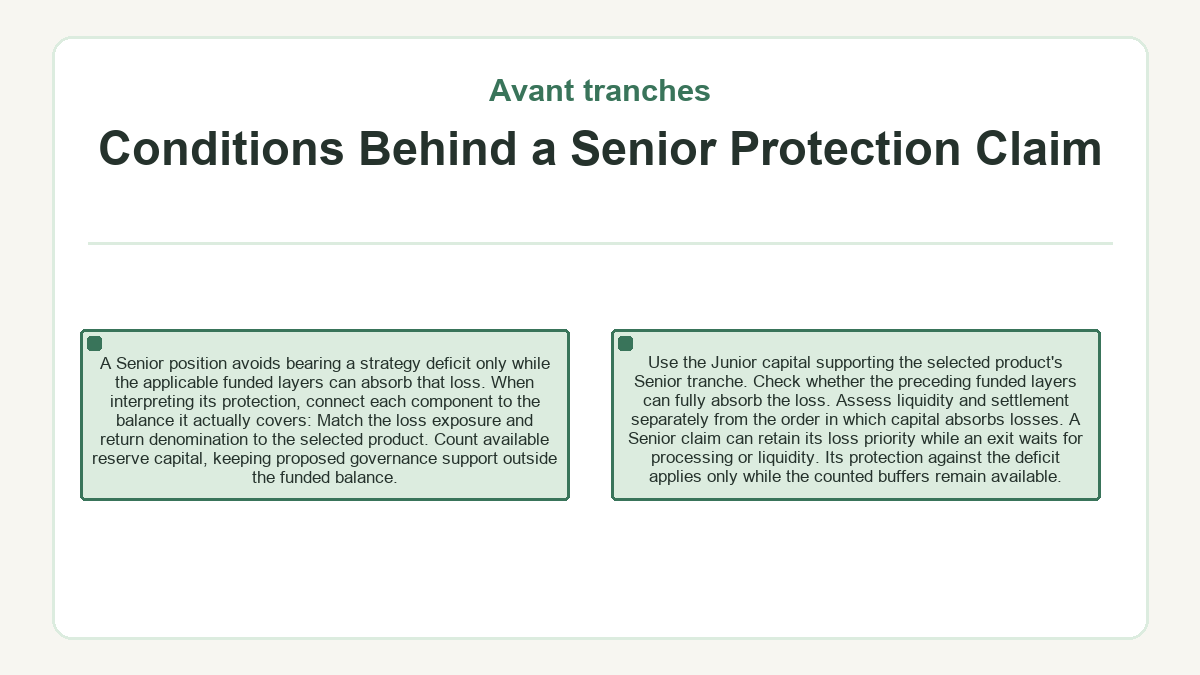
- Match the loss exposure and return denomination to the selected product.
- Count available reserve capital, keeping proposed governance support outside the funded balance.
- Use the Junior capital supporting the selected product's Senior tranche.
- Check whether the preceding funded layers can fully absorb the loss.
- Assess liquidity and settlement separately from the order in which capital absorbs losses.
A Senior claim can retain its loss priority while an exit waits for processing or liquidity. Its protection against the deficit applies only while the counted buffers remain available.
Product Families and Tranche Denominations
The product family determines the backing asset and return denomination; tranche rank determines the allocation within that family. The USDC-backed USD suite includes avUSD, savUSD, and avUSDx. The ETH suite includes avETH, savETH, and avETHx. Yield accruing in ETH doesn't remove ETH price exposure when the position's value is measured in dollars. Senior ranking concerns strategy-loss allocation within the product.
Bitcoin exposure has distinct BTC.b-backed and kBTC-backed families. The BTC.b suite is native to Avalanche and uses avBTC, savBTC, and avBTCx. The kBTC suite is native to Ink and uses avkBTC, savkBTC, and avkBTCx. Their shared BTC denomination doesn't make their backing assets interchangeable. Within the kBTC family, savkBTC carries the yield-bearing Senior position, while avkBTCx carries the additional Junior yield allocation and earlier strategy-loss exposure.
What readers ask about Avant tranches
Is the Junior Yield Allocation the Same as Avant's Performance Fee?
The Junior allocation distributes yield to committed Junior capital; Avant receives the protocol performance fee. The additional Junior allocation equals 10% of the corresponding main strategy's total yield. Avant's performance fee is 10% of strategy net profits, with a separate variable fee for trading partners. Neither percentage states the annual return a Junior holder will receive.
Can I Cancel a Junior Burn After Its Cancellation Window Closes?
RequestsManagerV2 requires an administrator to cancel a pending Junior burn after its user-cancellation window closes. The provider's cancelBurn call then reverts. The window is configurable, so a default duration doesn't establish the setting for every deployment. Administrator cancellation returns the escrowed Junior tokens to the original provider.
Do Pending Junior Mints Keep the Fee Quoted at Submission?
RequestsManagerV2 applies the mint fee active at completion, so a pending Junior mint doesn't lock its submission-time fee. An administrator's change can affect a mint awaiting settlement. Junior burns use different fee timing: they store the burn fee when the request is created and retain that fee for settlement.
What Happens to a Junior Request During a Contract Pause?
A RequestsManagerV2 pause blocks new requests and completion calls while leaving cancellation functions available under their existing conditions. A pending mint can remain cancellable by its provider. Junior burn cancellation still obeys the configured window, which continues to elapse during the pause. Once that window closes, administrator cancellation is required.
Does a Successful Junior Mint Request Mean the Tokens Have Arrived?
Creating a Junior mint request doesn't complete the conversion. The request escrows the input tokens, and an authorized service must subsequently complete it. RequestsManagerV2 calculates the output at completion and issues the Junior tokens to the provider. A request identifier establishes a recorded request; it doesn't establish delivery of the output balance.
Can Any 18-Decimal Token Fund a Junior Vault?
A deposit token must be allowed by the vault's request manager; matching decimal precision isn't sufficient. RequestsManagerV2 expects approved standard ERC-20 tokens with compatible price denomination. Its decimal check doesn't establish all those properties. These integration requirements don't permit replacing the product's base token with an arbitrary asset.
Will Bridging a Junior Token Change Its Tranche?
A supported bridge transfer preserves the Junior exposure instead of converting it into a Senior position. Bridge support varies by token family and destination. The avkBTC family doesn't currently support bridging. Network availability and tranche conversion are separate features, so a supported destination doesn't imply a different loss priority.
Does a Junior Vault's Price Guard Put a Fixed Floor Under Its Value?
PriceStorage bounds individual price updates without guaranteeing a permanent minimum token value. Its upper and lower limits are configurable relative to the preceding price. Successive permitted decreases can therefore reduce value over time. The guard constrains updates; available reserve capital and the loss waterfall determine economic protection.
Last updated